A 40-vial sequence on a 1260 Infinity II autosampler came back with a 4.8% RSD on the internal standard at the 12th injection, and the analyst had already swapped septa twice. The method ran 60 °C column temperature with a 100% ethyl acetate extraction solvent, and the closure was a silicone-lined screw cap. The silicone had swollen 0.6 mm in diameter after 18 hours of contact and was extruding into the needle path. That is not a mechanical failure. That is a polymer selection failure, and it is the single most common reason a method that worked in development falls apart in a production queue. Choosing an HPLC vial material for a given solvent and temperature is a materials compatibility decision, and it has a small number of correct answers. This guide is about those answers.
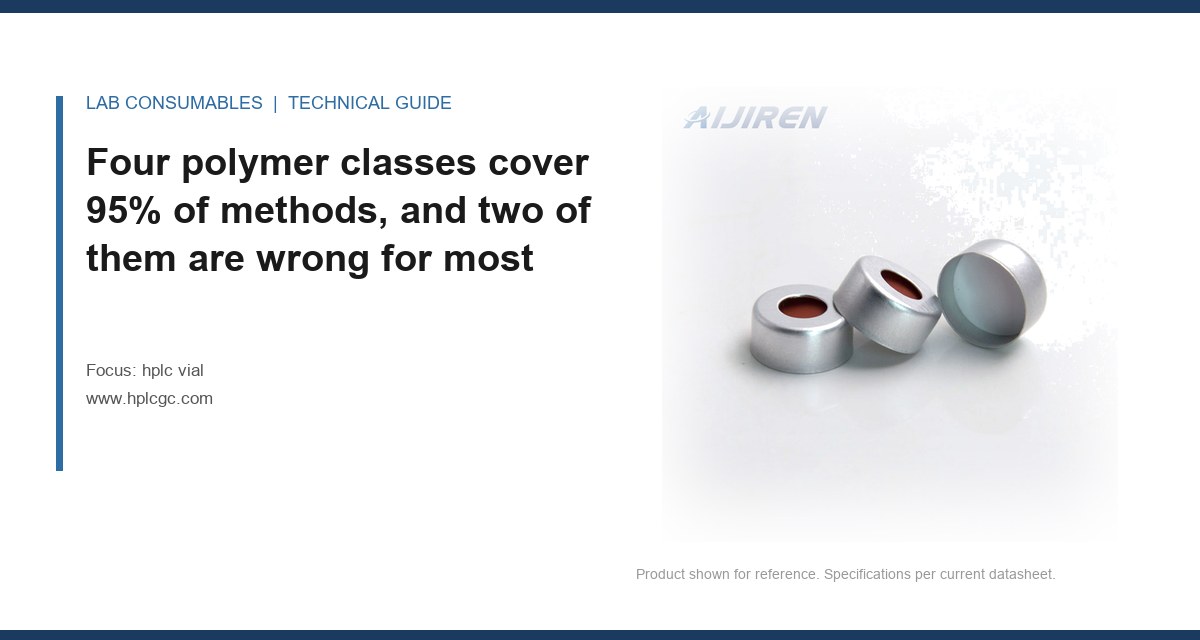
Four polymer classes cover 95% of methods, and two of them are wrong for most of them
Nearly every closure you will buy is built from one of four materials: PTFE, silicone, EPDM, or a laminate (typically PTFE-faced silicone). Each has a distinct solvent resistance profile, a distinct temperature window, and a distinct failure mode. Most procurement decisions treat these as interchangeable, which is why most labs over-buy silicone and under-buy laminate.
The base resin of the vial body matters too, but less than people think. Borosilicate 1.8.1 glass is inert to almost everything an HPLC method will throw at it, and the exceptions (strong alkali above pH 9, hydrofluoric acid, hot concentrated phosphoric) are rare enough that the body is almost never the wrong choice. The closure is where the decision lives.
PTFE: the solvent-inert default, with a temperature ceiling and a memory problem
PTFE is chemically inert against essentially every HPLC solvent, acid, and base in common use. It resists pH 0 to 14, tolerates acetone, DMSO, THF, dichloromethane, and hexane without swelling, and does not leach plasticizers because it has none. That is why a pure PTFE-faced septum is the right default for reverse-phase methods with aggressive solvents.
Two problems. First, PTFE creeps under compression. A septum that is 0.9 mm thick when new will thin to 0.7 mm after 24 hours under a screw cap torqued to 1.2 N·m, and the seal relaxes. Second, PTFE has a memory: once pierced, the hole does not close. A pure PTFE septum is effectively single-puncture. The puncture count on a PTFE-only closure is 1, maybe 2 if the needle is a 22-gauge side-port and you are lucky. Anything more and you are relying on the needle to seal against a hole it made.
Temperature window is roughly -100 °C to +260 °C, but the practical upper limit for a septum under a screw cap is closer to 150 °C because the cap and the septum’s own creep behavior start to fight each other. Above 150 °C, use a crimp closure, not a screw thread.
Silicone: excellent reseal, poor solvent resistance, and a hard temperature ceiling
Silicone is the reseal champion. A 1.0 mm silicone septum handles 10 to 20 punctures at 22-gauge without leaking, which is why it is the default in high-throughput autosampler workflows and in autosampler vial applications where the same closure is pierced repeatedly. It is also the wrong choice for most organic solvents.
Silicone swells in toluene, xylene, dichloromethane, chloroform, ethyl acetate, and THF. Swelling is not cosmetic: a swollen septum can extrude into the needle path, can lift the cap, and can shed silicone oil into the sample. The failure mode is a slow drift in peak area over a sequence, not a hard fail, which makes it hard to catch. Silicone also has a temperature ceiling of about 200 °C in continuous service, but the practical limit for a septum under compression is 120 °C before compression set becomes permanent.
Silicone is the right answer for aqueous and polar methods, for methanol/water and acetonitrile/water gradients, and for headspace applications where the closure is pierced once per vial. It is the wrong answer for anything with a log P above about 2 in the extraction solvent.
EPDM: the underused middle ground, with a pH limit
EPDM (ethylene propylene diene monomer) is a synthetic rubber with better chemical resistance than silicone and better reseal than PTFE. It handles ketones, alcohols, and dilute acids and bases well. It is the standard closure material for pharmaceutical methods running pH 2 to pH 10 mobile phases, and it is what I would specify for a method using 0.1% formic acid in water/acetonitrile if the lab wanted more than 5 punctures per vial.
The limits are real. EPDM is attacked by aromatic hydrocarbons, chlorinated solvents, and concentrated oxidizing acids. Above pH 11 it degrades, and below pH 1 it starts to lose tensile strength. Temperature ceiling is about 150 °C continuous, 130 °C under compression. Puncture count is typically 5 to 8 at 22-gauge.
Laminate (PTFE-faced silicone): the compromise that wins most methods
A laminate septum is a thin PTFE film bonded to a silicone core. The PTFE faces the sample and provides the solvent resistance; the silicone provides the reseal. Done well, this gives you PTFE-level chemical inertness with silicone-level puncture performance, which is why laminate is the correct default for 70 to 80% of reverse-phase HPLC methods.
Done badly, the bond fails. A laminate where the PTFE film delaminates under solvent attack will shed a 0.05 mm film into the sample, which shows up as an unexplained peak at the solvent front or as a blocked needle. The test is simple: soak a septum in your extraction solvent for 24 hours at your method temperature and inspect the bond line under a loupe. If the film lifts at the edge, reject the lot. Puncture count on a good laminate is 5 to 10 at 22-gauge. Temperature ceiling is set by the silicone core: 120 °C practical, 150 °C absolute.
For headspace work specifically, the laminate is usually the right answer because it reseals after the single pierce and does not outgas. See the headspace vial selection notes for the pressure-rating side of that decision.
The compatibility matrix, with the numbers that matter
Here is the working table I use. The temperature figures are practical service limits for a septum under a screw cap at 1.0 to 1.2 N·m torque, not the polymer’s absolute thermal rating.
| Material | Solvent resistance | pH range | Service temp (septum under cap) | Punctures at 22-gauge | Failure mode when wrong |
|---|---|---|---|---|---|
| PTFE (pure) | Excellent, all common HPLC solvents | 0 to 14 | -100 to 150 °C | 1 to 2 | Creep and seal relaxation; single-pierce limit |
| Silicone | Poor for aromatics, chlorinated, esters | 3 to 10 | -60 to 120 °C | 10 to 20 | Swelling, extrusion, silicone oil leaching |
| EPDM | Good for ketones, alcohols, dilute acids/bases | 1 to 11 | -50 to 130 °C | 5 to 8 | Degradation above pH 11; tensile loss below pH 1 |
| PTFE/silicone laminate | Excellent (PTFE face) | 0 to 14 | -60 to 120 °C | 5 to 10 | Delamination; film shedding into sample |
| PTFE/EPDM laminate | Excellent (PTFE face) | 0 to 11 | -50 to 130 °C | 5 to 8 | Delamination; base attack on EPDM core |
Two things to read from this table. First, the laminate rows dominate the middle of the decision space, which is why they should be the default unless you have a specific reason to move. Second, the failure mode column is what you should be matching to your analytical risk: a swelling failure drifts slowly and is caught by trend review, while a delamination failure is sudden and produces a discrete artifact. If your lab reviews system suitability per injection, either is catchable. If you review per batch, the delamination failure is the one that gets through.
Matching the polymer to the method: a decision rule, not a preference
The selection question is not “which material is best.” It is “which material survives the extraction solvent and the method temperature without changing the sample.” That is a two-variable problem, and the answer is almost always determined by the solvent’s Hansen solubility parameters relative to the polymer, with temperature as a multiplier.
Step 1: classify the extraction solvent
Ask one question: is the extraction solvent primarily aqueous, or primarily organic? If aqueous (water, buffer, methanol/water, acetonitrile/water up to about 60% organic), silicone or EPDM is fine and gives you the best puncture count. If primarily organic (greater than 60% acetonitrile, methanol, or any of the chlorinated, aromatic, or ester solvents), you need a PTFE face. There is no middle ground here. Silicone in 100% acetonitrile will swell measurably within 8 hours at room temperature.
Step 2: apply the temperature multiplier
Every polymer’s solvent resistance degrades with temperature. A solvent that is marginal at 25 °C becomes a failure at 60 °C. Rule of thumb: if your method temperature is above 50 °C, drop one class in the table above. A silicone septum rated for 120 °C against acetonitrile at room temperature is not rated for 120 °C against acetonitrile at 80 °C. It is rated for about 40 °C.
Step 3: check the pH against the polymer, not the glass
The glass body handles pH 1 to 13 without argument. The septum does not. EPDM fails above pH 11. Silicone is marginal above pH 10. PTFE and PTFE-faced laminates are the only closures that tolerate the full pH 0 to 14 range. If your method runs a pH 12 phosphate buffer, you are on PTFE or laminate, no exceptions.
Step 4: set the puncture budget
Count the injections per vial. If the method injects once per vial (single-injection autosampler), a PTFE septum is fine and gives you the best chemical inertness. If the method injects 5 or more times per vial (common in stability studies and in some QC sequences), you need a reseal-capable material: silicone, EPDM, or laminate. A pure PTFE septum on a 6-injection-per-vial sequence will leak by injection 3.
The HPLC vial catalog pages carry the puncture rating for each closure, but the number that matters is the one you measure in your own method, not the one on the datasheet. Datasheet puncture counts are measured with a fresh 22-gauge needle at 1.0 N·m torque on a new cap. Your needle is not fresh, your torque is not 1.0 N·m, and your cap has been through a tray handler.
Two field cases where the polymer was the root cause
Case 1: the drifting internal standard
Symptom: a 40-injection sequence on a stability study showed the internal standard area drifting from 100% at injection 1 to 92% at injection 40, with no change in retention time and no change in peak shape. System suitability passed the first 20 injections and failed at 28.
Measurement: we pulled the vial closures at injection 20 and measured septum thickness with a micrometer. The silicone septa had gone from 1.02 mm to 0.84 mm, and the diameter had grown 0.4 mm. The method used 80:20 acetonitrile:water at 55 °C. The swelling was pulling the septum into the headspace and the reseal was failing between injections, so each injection was sampling a slightly different headspace equilibrium.
Fix: switched to a PTFE/silicone laminate at the same 1.0 mm thickness. The drift disappeared. RSD dropped from 4.8% to 0.9% over the same 40 injections. The cost per vial went up about $0.04. The cost of the failed sequence was 40 vials of sample prep and a re-run.
Case 2: the mystery peak at 1.8 minutes
Symptom: a new lot of vials produced an extra peak at 1.8 minutes in every injection, area about 0.3% of the main peak, in a method that had run clean for two years. The peak was not present in blank injections of mobile phase, only in sample injections.
Measurement: we soaked 10 closures from the suspect lot in the extraction solvent (dichloromethane) for 4 hours at room temperature and injected the soakate. The peak was there, at the same retention time. Inspecting the septa under a 10x loupe showed the PTFE film lifting at the edge of 3 of the 10. The laminate bond had failed, and the silicone core was leaching into the sample.
Fix: rejected the lot, moved to a different supplier’s laminate with a documented bond-line spec, and added a soak test to the incoming inspection for every new lot of closures. The soak test takes 4 hours and costs about $15 in solvent and a single injection. It has caught two more bad lots since.
Operational precautions that decide whether the right polymer actually works
Selecting the correct material is necessary but not sufficient. The following are the operational details that determine whether a correctly chosen septum performs as designed.
- Torque. Screw caps should be torqued to 1.0 to 1.2 N·m. Below 0.8 N·m the seal is incomplete and the septum can lift. Above 1.5 N·m the septum is over-compressed, which accelerates creep in PTFE and compression set in silicone. A torque wrench with a 0.1 N·m resolution is a $200 item that pays for itself in one avoided re-run.
- Needle gauge. A 22-gauge needle (0.72 mm OD) is standard. A 26-gauge needle (0.46 mm OD) reduces the puncture hole by 60% and lets you get 2 to 3 more punctures from a PTFE septum, at the cost of slower draw and a higher risk of clogging with viscous samples.
- Pierce depth. The needle should penetrate the septum by at least 2 mm and no more than 6 mm. Too shallow and the needle can pull the septum into the vial on withdrawal; too deep and the needle can hit the bottom of the vial and bend.
- Solvent soak test. Before committing a lot to a validated method, soak 10 closures in the extraction solvent at the method temperature for 24 hours. Weigh before and after. A mass change above 3% is a rejection. A visible change in dimension above 0.2 mm is a rejection.
- Lot traceability. Record the lot number of every closure used in a validated method. When a failure occurs, the lot is the first thing you will want, and it is the first thing that is missing if you did not record it.
- Storage. Silicone and EPDM closures absorb volatiles from the air. Store in a sealed bag with a desiccant, not in an open tray on the bench. A septum that has been on the bench for a week is not the septum that was qualified.
For method-specific guidance, the U.S. EPA SW-846 methods are a useful reference because they specify the container as part of the method, and the container specification includes the closure material. The Restek technical library has good compatibility charts for the solvent classes that give people the most trouble. Vendor application notes from Agilent and Thermo Fisher are worth reading for the autosampler-specific handling notes, which differ between the 1260, the Vanquish, and the Acquity in ways that affect septum life.
Troubleshooting checklist: reading the failure to find the polymer
When a method fails and the polymer is suspect, the following sequence isolates the cause in about 2 hours.
- Is the failure time-dependent or injection-number-dependent? If it worsens with injection number, the septum is losing reseal (wrong material for the solvent, or over-punctured). If it worsens with time on the autosampler, the septum is swelling or leaching (wrong material for the solvent).
- Is the failure present in the blank? If yes, the closure is leaching. Run a soak test. If no, the closure is failing to seal, and you are losing sample to the headspace or gaining air.
- Measure the septum. Thickness and diameter before and after the run. A thickness loss above 0.1 mm or a diameter growth above 0.2 mm means the material is wrong for the method, not that the lot is bad.
- Check the torque. A torque below 0.8 N·m produces a leak that looks like a material failure. Re-torque a test set and repeat.
- Check the method temperature. A method that runs at 60 °C with a silicone septum is a method that will fail. Drop one material class.
- Check the pH. A method at pH 12 with an EPDM closure will fail. Move to PTFE or laminate.
The vial selection resources across the network carry the closure compatibility charts in a single page, which is faster than rebuilding the table from scratch. Use them as a starting point, then verify with your own soak test.
The decision rule
Match the closure to the method on two variables, solvent class and temperature, and accept that the answer is usually a PTFE-faced laminate. Use pure PTFE when the method is single-injection and the solvent is aggressive; use silicone when the method is aqueous and puncture count matters more than solvent resistance; use EPDM when the method runs pH 2 to 10 with a ketone or alcohol and you want more reseal than PTFE offers. Verify the choice with a 24-hour soak at method temperature before the lot enters a validated method, and record the lot number. The septum is the only part of the vial that contacts the sample and changes its properties during the run. Treat the material selection as a method parameter, because that is what it is.
References & further reading
Related resources from our lab consumables network:
- Hplc Vial at hplcgc.com
- Autosampler Vial at autosamplerhplc.com
- Vial at vials-filters.com
- Headspace Vial at headspacevialsupplier.com
External references and standards: