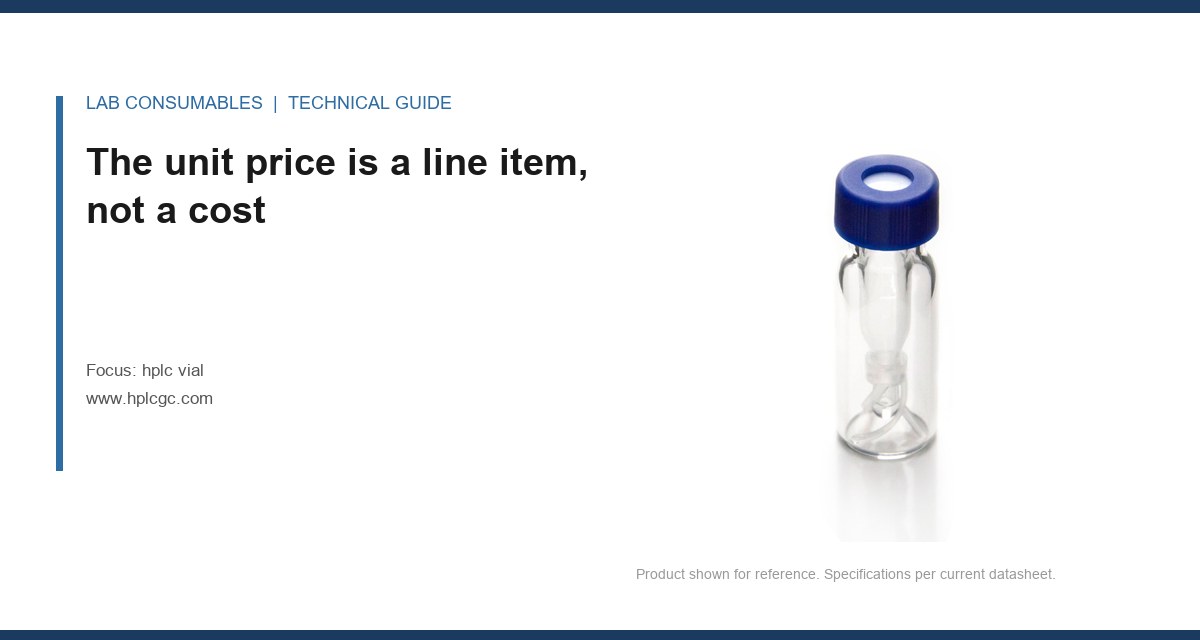
A 2 mL HPLC vial with a PTFE/silicone septum costs $0.11 from a supplier in Shenzhen. That same vial, after freight, customs brokerage, duty, incoming inspection, cold storage for three months, and a 1.8% capping defect rate caught only after your autosampler needle bends, costs $0.31 per usable unit. If you are still comparing vendors on unit price alone, you are not buying vials. You are buying a lottery ticket with extra paperwork. This is the hplc vial landed cost calculation that procurement software does not show you.
I have sat on both sides of this table. I ran a chromatography consumables distribution business for years, and I now write specifications for labs that buy in bulk. The pattern is always the same. A procurement manager sends me three quotes. The cheapest quote wins. Six months later, the lab manager calls because 40 vials out of a 1,000-vial case are shedding septum particles into the mobile phase. The savings from the unit price have already been spent on column replacement and rerun time. A real landed cost calculation starts with the invoice price, then adds everything that happens between the factory gate and the moment a clean chromatogram appears.
The line items most people forget are inspection labor, storage conditions, failure replacement, and the cost of a run that fails silently. A vial that caps properly but leaks solvent at 12°C below room temperature does not announce itself. It produces a drifting baseline, a ghost peak, or a pressure ripple. The analyst spends 45 minutes troubleshooting the pump when the problem is sitting in the autosampler tray. That 45 minutes is a landed cost item.
Freight is a function of air volume, not vial weight
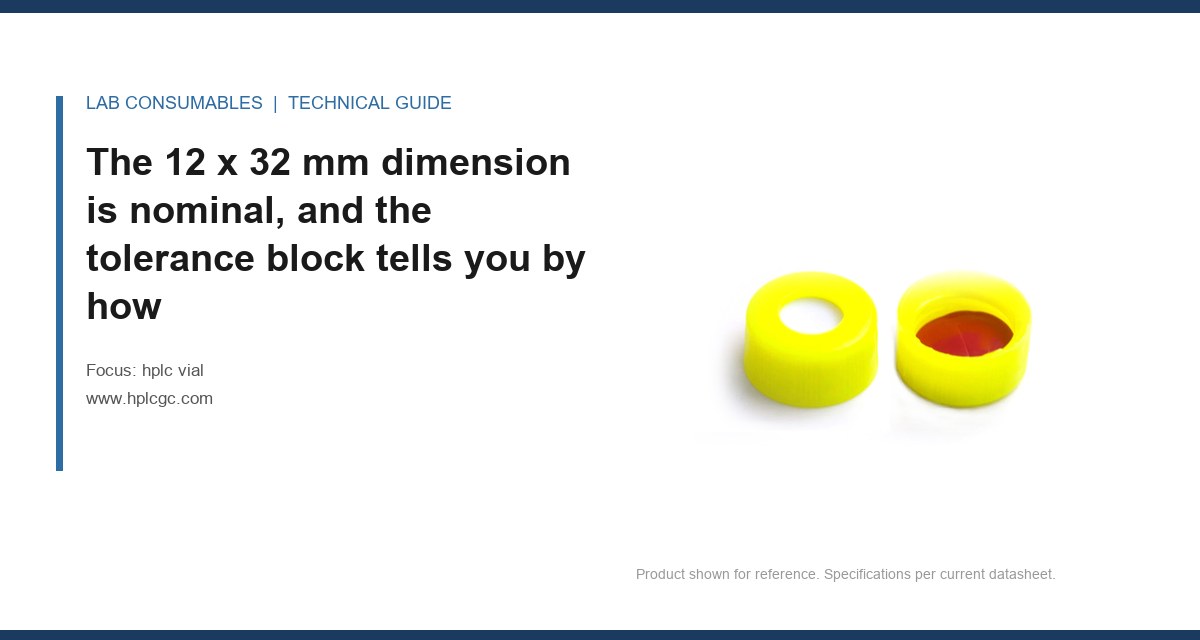
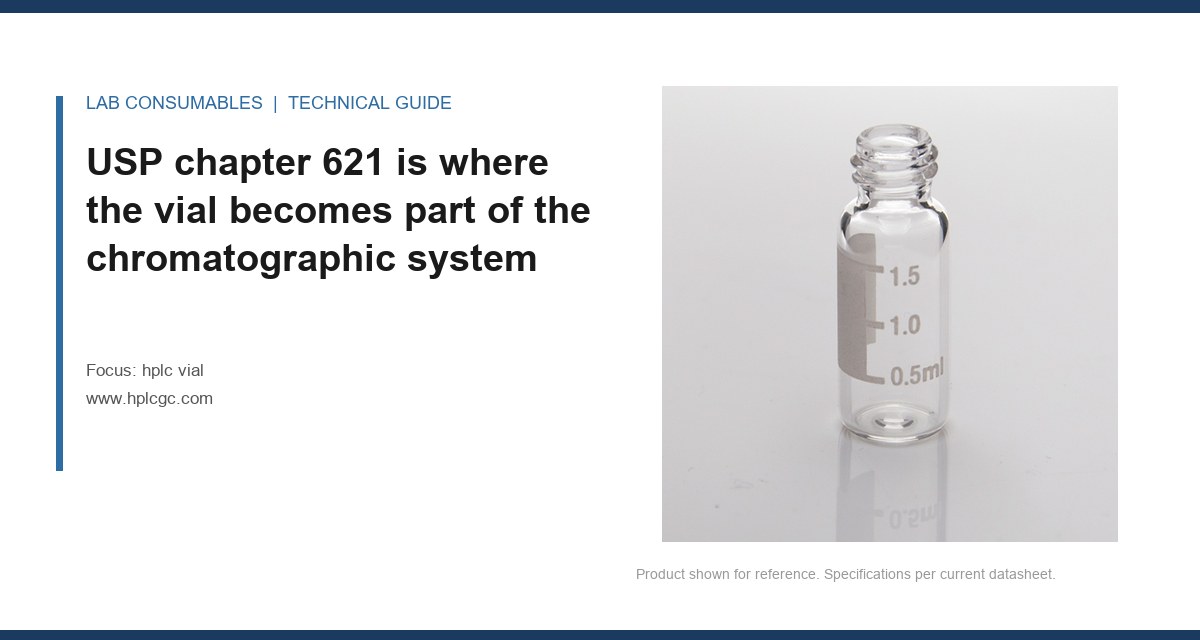
HPLC vials are light. A case of 1,000 2 mL vials weighs about 4.8 kg. But the shipping carton is mostly air. The vial itself is 32 mm tall and 12 mm in outer diameter. Packed in trays of 100, with foam dividers and an outer carton, the volumetric weight of that case often exceeds 9 kg under IATA dimensional weight rules. If you are importing from Asia by air freight, you are paying for 9 kg, not 4.8 kg.
Here is a real number from a shipment I tracked in 2023. A pallet of 120 cases, 120,000 vials, gross weight 576 kg. Volumetric weight after palletizing: 1,140 kg. Air freight rate from Shanghai to Chicago at the time was $6.80/kg chargeable. That is $7,752 in freight for a product whose invoice value was $13,200. Freight added 58.7% to the unit cost before a single customs form was filed. If you are comparing a domestic supplier at $0.18 per vial to an overseas supplier at $0.11, the freight on that shipment brings the overseas vial to $0.174. The gap is gone.
Ocean freight is cheaper per kilogram but slower and more variable. A 40-foot container of vials can sit at the port of Long Beach for 11 days. If your lab runs USP EPA SW-846 methods and you are holding 90 days of inventory as a buffer, the carrying cost of that buffer is a landed cost item. The procurement rule is simple: if you cannot quote a chargeable weight, you do not know the freight cost. Ask the supplier for the carton dimensions and the pallet configuration before you compare quotes.
Duty and customs brokerage hide in the fine print
HPLC vials made from borosilicate glass fall under Harmonized System heading 7017.90, laboratory glassware. The general duty rate into the United States for most countries of origin is 5% to 6.5%, depending on the specific subheading and any trade agreements. If the vials are packaged with septa and caps assembled, the classification can shift to a composite good, and customs brokers will sometimes classify the entire set under a different heading with a different rate. I have seen two brokers classify the same shipment of capped vials two different ways, with a $1,100 difference in duty on a $22,000 shipment.
Brokerage fees run $75 to $150 per entry, plus a merchandise processing fee of 0.3464% of the entered value, capped at $634.62 per entry as of 2024. For a small shipment of 10 cases, that is $150 in brokerage plus $45 in MPF on a $13,000 invoice. These are small numbers per vial, but they are not zero. A $0.11 vial becomes $0.117 after duty and brokerage. If your margin on a resale is 20%, that 0.7 cent is 3.5% of your margin. Procurement managers who ignore this are quietly giving away margin on every case.
The bigger risk is misclassification. If your supplier declares the vials as “glass articles” under a lower-duty heading and the shipment is audited, you owe back duty plus interest and possibly a penalty. The fix is to demand the HTS code in writing from the supplier before you order, then verify it with your own broker. Do not accept “we handle customs” as an answer. You handle customs. The supplier just fills out the form you give them.
Incoming inspection is where the cheap vial gets expensive
You cannot skip incoming inspection on HPLC vials. The failure modes are too many and too quiet. I have opened cases from three different factories and found the same defect: a septum that is 0.2 mm off-center in the cap. The vial caps fine. The autosampler needle pierces the septum at the edge instead of the center. The needle hits the cap skirt, bends, and the run aborts. A $0.11 vial just cost you a $350 needle and 20 minutes of downtime.
A proper incoming inspection for a 1,000-vial lot takes about 45 minutes if you know what you are looking for. You check:
- Dimensional conformance: outer diameter 11.6 ±0.2 mm, height 32 ±0.25 mm for a standard 2 mL vial. Use a calibrated caliper, not a ruler.
- Cap torque: for screw caps, the closure should seat at 0.11 to 0.17 N·m. Below 0.08 N·m, the vial leaks under autosampler pressure. Above 0.22 N·m, the septum deforms and the needle requires excessive force.
- Septum puncture count: a PTFE/silicone septum rated for 100 punctures should survive 100 punctures without coring. Test 10 vials from the lot, 20 punctures each, and inspect the septa under a stereomicroscope for particles.
- Visual clarity: the glass should be Type 1 borosilicate, clear, with no visible cords, stones, or scratches. A scratch is a stress concentrator. Under autosampler pressure, a scratched vial can crack.
- Cleanliness: a rinse with HPLC-grade methanol followed by evaporation should leave no residue. If you see a film, the vials were not washed properly after forming.
If your lab does not have the time to do this, you pay someone else to do it. Third-party inspection labs charge $300 to $600 per lot depending on the test plan. That is $0.30 to $0.60 per vial on a 1,000-vial lot. It is still cheaper than discovering the defect after the vials are in the autosampler.
Storage is a cost, not a warehouse detail
HPLC vials are not inert until use. The septum is a polymer composite. Silicone absorbs volatile organic compounds from the air. PTFE is more resistant but not impermeable. If you store vials in a warehouse that also stores solvents, adhesives, or cleaning chemicals, the septa will pick up those volatiles. The first injection from those vials will show ghost peaks. I have traced a recurring unknown peak at 4.7 minutes to a pallet of vials stored 3 meters from a pallet of floor wax stripper.
Storage temperature matters. PTFE/silicone septa are rated for continuous use from -40°C to 200°C, but storage above 30°C accelerates silicone outgassing. If your warehouse hits 38°C in August and the vials sit there for two months, the septa will be compromised before the first puncture. Cold storage at 4°C to 8°C is better, but it costs money. A refrigerated storage unit for a pallet of vials runs $40 to $80 per month. On a 120,000-vial inventory, that is $0.0004 per vial per month. Small, but real.
The bigger storage cost is inventory carrying cost. If you hold 90 days of inventory at a landed cost of $0.20 per vial and your cost of capital is 8% annually, the carrying cost is $0.004 per vial. That is 2% of the landed cost. It is not the largest line item, but it is the one that never appears on the purchase order.
The failure cost is the one that breaks your budget
Every batch of vials has a defect rate. The question is whether you catch the defects before they reach the autosampler or after. A factory with a good quality system will ship vials with a defect rate below 0.5%. A factory without one will ship at 2% to 5%. The difference is not visible on the invoice.
Here is a worked example. You buy 10,000 vials at $0.11 each. Invoice cost: $1,100. Freight, duty, brokerage, and inspection bring the landed cost to $0.16 per vial, or $1,600 total. The lot has a 2% defect rate. That means 200 vials will fail in use: cracked glass, leaking septa, misaligned caps. Each failure costs you:
- A rerun: 30 minutes of instrument time at $120/hour, or $60
- Solvent and consumables for the rerun: $8
- Analyst time to troubleshoot and rerun: 20 minutes at $65/hour, or $22
- Potential column damage from septum particles: $50 to $400, amortized per failure at $10
A conservative failure cost is $100 per failed vial. With 200 failures, that is $20,000 in failure costs on a $1,600 purchase. The cost per usable vial is not $0.16. It is ($1,600 + $20,000) / 9,800 usable vials = $2.20 per usable vial. That is a 13.75x multiplier over the landed cost, and a 20x multiplier over the invoice unit price.
Now run the same calculation with a supplier whose defect rate is 0.3%. You pay $0.18 per vial, landed cost $0.24. On 10,000 vials, that is $2,400. Thirty vials fail. Failure cost: $3,000. Cost per usable vial: ($2,400 + $3,000) / 9,970 = $0.54 per usable vial. The cheaper vial costs 4x more per usable unit. This is the hplc vial landed cost calculation that matters, and it is the one that never shows up in a quote comparison spreadsheet.
A comparison table that makes the trade-off visible
Here is a side-by-side comparison of two real supplier profiles I have worked with. The numbers are from actual shipments, not a generic model.
| Cost item | Supplier A (low unit price, offshore) | Supplier B (higher unit price, audited) |
|---|---|---|
| Invoice unit price | $0.11 | $0.18 |
| Freight per vial (air, volumetric weight) | $0.042 | $0.018 (domestic truck) |
| Duty and brokerage per vial | $0.008 | $0.000 |
| Incoming inspection per vial | $0.005 | $0.002 (reduced sampling due to audit history) |
| Landed cost per vial | $0.165 | $0.200 |
| Defect rate | 2.0% | 0.3% |
| Failure cost per failed vial | $100 | $100 |
| Cost per usable vial | $2.20 | $0.54 |
| Rerun rate attributable to vials | 1 in 50 runs | 1 in 333 runs |
The decision is not close. The supplier with the higher unit price is cheaper by a factor of four when you count the cost of using the vial, not just buying it. If your procurement system only tracks invoice price, it is actively steering you toward the worse supplier.
Case study: the 0.2 mm off-center septum
A contract lab in New Jersey was running 300 injections per day on a single quadrupole LC-MS system. They switched to a new vial supplier to save $0.04 per vial. Within two weeks, the autosampler needle was bending twice a week. Each bent needle cost $380 to replace and 40 minutes of downtime. The lab manager assumed the autosampler was out of alignment and called a service engineer. The engineer found the autosampler in spec. The problem was the vials.
I asked the lab to send me 50 vials from the lot. I measured the septum position in the cap using a calibrated optical comparator. The septa were off-center by an average of 0.18 mm, with a maximum of 0.27 mm. The specification for that cap design is a maximum eccentricity of 0.10 mm. The needle was piercing the septum near the edge, hitting the cap skirt, and bending. The fix was to reject the lot and return to the previous supplier. The lab saved $400 on the purchase and spent $1,900 on needles and service calls in two weeks. The procurement manager still lists the new supplier as “cost saving” in the quarterly report because the system only tracks invoice price.
Case study: the silicone that outgassed at room temperature
A pharmaceutical QC lab in Ireland was seeing a ghost peak at 3.2 minutes in a reversed-phase method for a small-molecule API. The peak appeared intermittently, roughly one in every 40 injections. The analyst spent three days troubleshooting the mobile phase, the column, and the autosampler wash station. Nothing fixed it.
I suggested they run a blank injection from a new vial, then from a vial that had been sitting in the autosampler tray for 24 hours. The fresh vial was clean. The 24-hour vial showed the ghost peak. The septa were outgassing a volatile compound that accumulated in the vial headspace over time. The supplier had changed the silicone formulation without notifying the lab. The new formulation had a higher level of low-molecular-weight siloxane oligomers. The fix was to switch to a PTFE-faced septum with a different silicone grade and to specify a maximum outgassing level in the purchase specification. The lab now runs a headspace GC-MS screen on every new lot of vials before release. That screen costs $180 per lot. It is a landed cost item, and it is cheaper than three days of analyst time.
The inspection checklist that pays for itself
If you are buying vials in bulk, you need a written incoming inspection procedure. Here is the checklist I use. It takes 45 minutes and catches 90% of the defects that cause field failures.
- Sample size: for a lot of 1,000 to 10,000 vials, sample 20 vials. For lots over 10,000, sample 32 vials. Use ANSI/ASQ Z1.4 General Inspection Level II as the basis.
- Dimensional check: measure outer diameter, height, and neck ID on 5 vials. For a 2 mL vial, the neck ID should be 9.0 ±0.2 mm for a 9 mm screw cap.
- Cap torque test: apply a torque meter to 10 caps. The seating torque should be 0.11 to 0.17 N·m. Record the average and range.
- Septum puncture test: puncture 5 septa 20 times each with a clean 23-gauge needle. Inspect under a stereomicroscope for coring. Any visible septum material in the vial is a reject.
- Closure integrity test: fill 5 vials with 1.5 mL of methanol, cap them, and place them inverted on a sheet of filter paper for 24 hours. Any wet spot is a leak.
- Cleanliness test: rinse 5 vials with 1 mL of HPLC-grade methanol each, pool the rinses, evaporate, and check for residue. A visible residue is a reject.
- Headspace outgassing test: cap 3 vials empty, heat to 60°C for 1 hour, then inject the headspace into a GC-MS. Any peak above 0.1% of the total ion current is a reject.
This checklist is not optional. If your supplier cannot provide a certificate of analysis that matches these tests, you are the quality department. You either do the work or you pay for the failures later.
Where the hplc vial landed cost calculation breaks down in practice
The formula is simple in theory: landed cost per usable vial equals (invoice cost plus freight plus duty plus inspection plus storage) divided by (total vials minus failed vials), plus the failure cost per failed vial times the failure count divided by usable vials. In practice, the failure cost is the number nobody wants to measure. It requires tracking reruns by root cause. Most labs do not do that. The autosampler logs a run as “failed” and the analyst moves on. The vial is never identified as the cause.
If you want the real number, you need to change the way your lab records failures. Add a field to the run log for “suspected vial issue.” After a month, count the entries. If the number is above 1 per 500 runs, your vial supply is costing you more than you think. I have seen labs where the number was 1 in 40 runs and the lab manager had no idea because nobody was counting.
The other place the calculation breaks down is when procurement and the lab do not talk. The procurement manager sees the invoice price. The lab manager sees the failures. Neither sees the full picture. The fix is to put the landed cost per usable vial on the purchase order. Not the unit price. The landed cost per usable vial. That number, updated quarterly, changes the conversation from “who is cheapest” to “who is actually cheaper to use.”
For sourcing, I recommend starting with a supplier that publishes its dimensional specifications and quality test data. The Hplc Vial range at hplcgc.com includes full dimensional drawings and lot-specific certificates of analysis. For autosampler-specific vials, check Autosampler Vial for compatibility data. For general laboratory vial specifications, Vial has a useful cross-reference table. If your method uses headspace sampling, Headspace Vial covers the pressure and temperature ratings you need.
On the instrument side, Agilent chromatography consumables and columns publishes compatibility data for their autosampler vial trays. Thermo Fisher chromatography and sample handling has application notes on vial cleanliness for trace analysis. For method-specific guidance on vial handling under U.S. EPA SW-846 test methods for waste and materials, the EPA method documents specify vial washing and storage protocols. Restek technical resources for chromatography has a useful reference on septum bleed and ghost peaks.
The decision rule
Stop comparing unit prices. Calculate the landed cost per usable vial, including freight at chargeable weight, duty at the correct HTS code, incoming inspection at the sample size your lot requires, storage at your actual conditions, and failure cost at your actual rerun rate. If a supplier cannot give you the data to do that calculation, treat the missing data as a cost, not a discount. The vial that costs $0.11 on the invoice and $2.20 in the autosampler is not a bargain. It is a liability with a purchase order attached.
References & further reading
Related resources from our lab consumables network:
- Hplc Vial at hplcgc.com
- Autosampler Vial at autosamplerhplc.com
- Vial at vials-filters.com
- Headspace Vial at headspacevialsupplier.com
External references and standards: