Last Tuesday I watched a 96-vial sequence drift from 0.8% RSD to 4.1% RSD on the same caffeine standard, and the only thing that changed between injection 12 and injection 48 was the vial. The method had been validated three years earlier, the autosampler passed its quarterly PM, and the column had 400 injections on it. The USP requirements for HPLC vial in a validated method do not give you a pass/fail certificate for that vial, but they do tell you which chapters apply, what the compendial language actually means, and where the burden falls back on the lab. Most analysts I meet have never read the relevant USP sections end to end. They inherit a vendor part number in a method SOP and assume someone upstream did the thinking. That assumption is expensive.
USP chapter <621> is where the vial becomes part of the chromatographic system
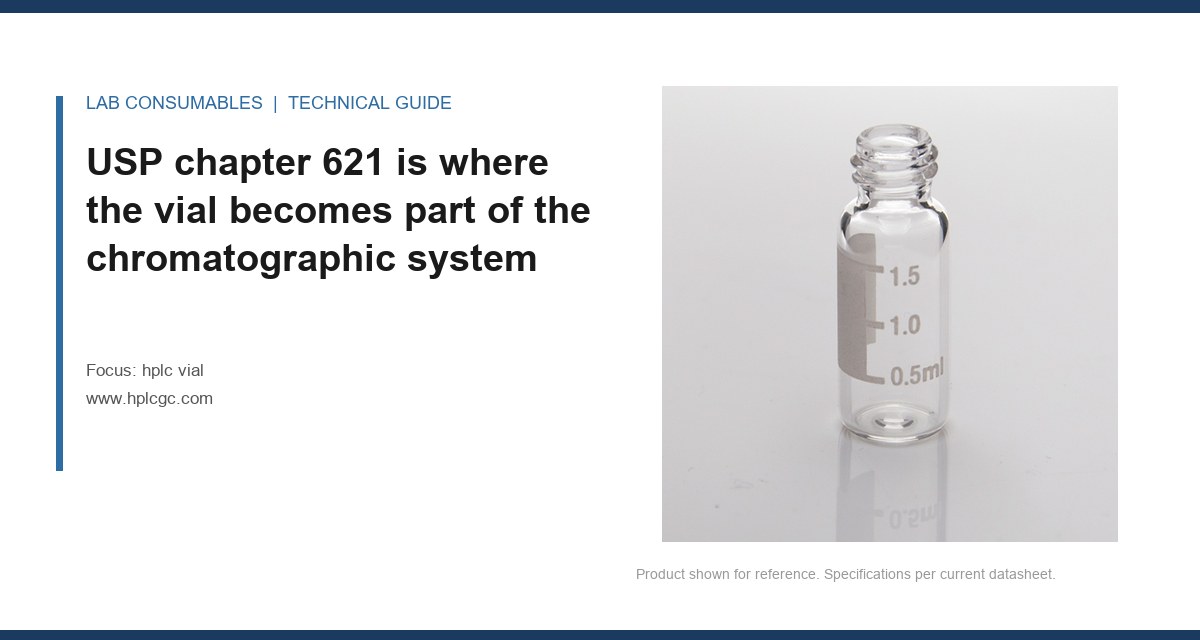
USP General Chapter <621> Chromatography does not mention the word “vial” often, but it defines system suitability in a way that makes the vial inseparable from the system. When you inject a reference standard and calculate tailing factor, plate count, and repeatability, the measured values include every surface the sample touches from the moment it leaves the pipette tip to the moment it reaches the detector. That includes the glass interior, the septum, the cap, and the small volume of headspace above the liquid. If the vial adsorbs an analyte, leaches a contaminant, or allows evaporation, the system suitability numbers reflect it. A lab can pass system suitability with a bad vial and still fail later in the sequence, but you cannot separate the two in a validated method. The chapter requires that system suitability be established before and during the run, and it assumes the sample container is inert enough not to contribute variability above the acceptance criteria.
What <621> does not do is specify a vial material, a septum formulation, or a closure type. That silence is deliberate. USP chapters are performance-based where possible, and the specific consumable is left to the method developer. In practice, that means the validated method must contain a defined vial specification, and any change to that specification is a change to the method. If the original method validation used a 9 mm screw-top clear glass vial with a PTFE/silicone septum, and the lab later substitutes a 9 mm snap-top polypropylene vial with a butyl septum, that is a method change. The lab owns the burden of demonstrating equivalence. I have seen two warning letters in the last five years where a firm changed vial suppliers without documenting the change, and the FDA investigator cited the absence of a vial specification in the method as a data integrity gap.
USP <660> and <661.1> are the only chapters that give you actual test numbers for glass and elastomers
If you want a compendial specification with pass/fail limits for the materials in an HPLC vial, you go to USP <660> Containers—Glass and USP <661.1> Plastic Materials of Construction. These chapters classify glass by hydrolytic resistance. Type I borosilicate glass, the standard for HPLC vials, must meet the surface glass test with a limit of 0.10 mL of 0.020 N sulfuric acid per gram of glass for the surface etch test, or the corresponding limit in the glass grains test. Type II glass is soda-lime-silica with a dealkalized inner surface. Type III is untreated soda-lime glass. For a validated HPLC method, Type I is the default choice because it minimizes sodium and other alkali leaching into aqueous mobile phases. The leached ions can appear as ghost peaks in ion chromatography or shift retention times in reverse-phase methods with low buffer capacity.
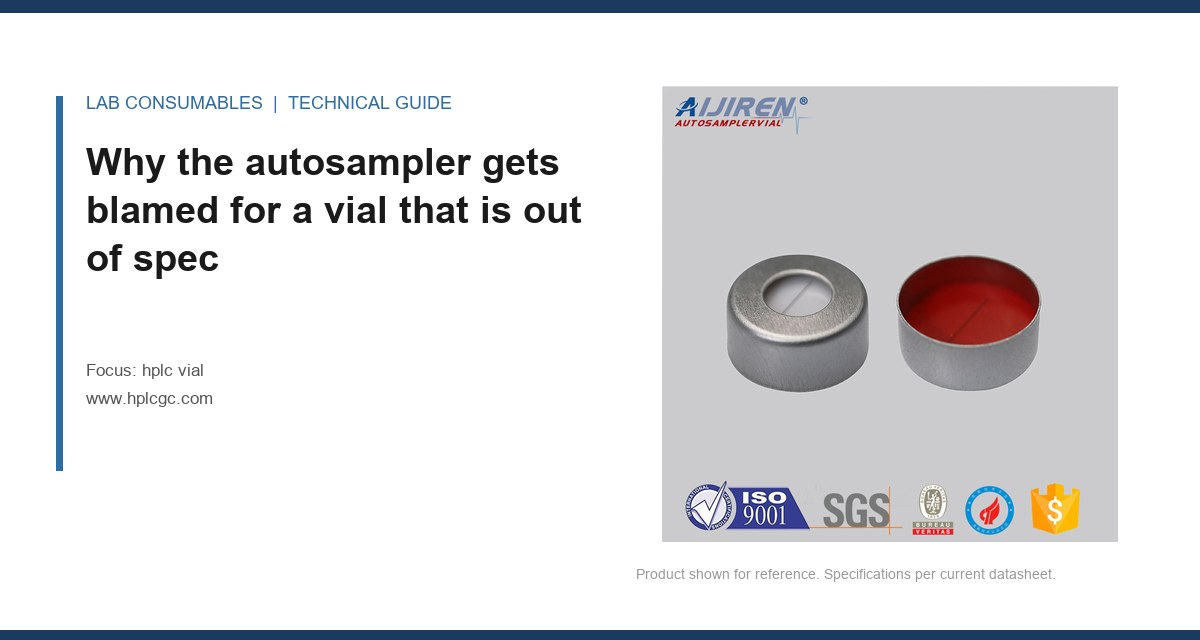
The elastomer part of the autosampler vial is covered by <381> Elastomeric Closures for Injections and the material-specific tests in <661.1>. These chapters set limits on extractables, volatile sulfides, and heavy metals. A PTFE-faced silicone septum that passes <381> has been tested for penetrability, self-sealing, and fragmentation. The fragmentation test is the one that matters most for HPLC: the septum must not shed visible particles after a specified number of needle punctures. The compendial test uses a 21-gauge needle, which is close to the 22S or 23 gauge needles used on many autosamplers. A septum that passes the compendial test can still core with a 26 gauge needle at high puncture counts, because the test conditions do not match every autosampler geometry.
What <660> and <381> give you is a floor, not a ceiling. They tell you the material is suitable for pharmaceutical use. They do not tell you the vial will be analytically clean for a specific method at a specific detection limit. That is the gap every lab has to close on its own.
The compendial chapters stop at material suitability; the validated method has to close the analytical cleanliness gap
Here is the part most method validation protocols miss. USP <660> says the glass is Type I. USP <381> says the septum passes fragmentation. Neither chapter says anything about phthalates, siloxanes, or residual monomers that elute at your specific detection wavelength. A PTFE/silicone septum can leach cyclic siloxanes (D3 through D6) that show up as discrete peaks in a GC-FID method or as baseline drift in a UV method at 210 nm. A polypropylene cap can leach antioxidant additives like Irganox 1010 or Irgafos 168 into an organic solvent. The USP chapters do not test for these because they are method-specific extractables, not compendial material properties.
That means the validated method must include a vial blank test. For a new method, I run the following sequence at least three times: inject the mobile phase from a vial that has been filled and capped for the same duration as a real sample, then inject a standard at the limit of quantitation, then inject the same standard after it has sat in the vial for the maximum time a sample would wait in the autosampler queue. The acceptance criterion is simple: no peak in the vial blank greater than 10% of the LOQ peak area at the retention time of any target analyte, and no new peak greater than that threshold anywhere in the chromatogram. If the vial fails, I change one variable at a time: the septum formulation first, then the glass surface treatment, then the cap material. In my experience, the septum is the source of contamination in roughly 70% of cases, the cap in 20%, and the glass in 10%.
For a method that is already validated, the same logic applies when you qualify a new vial supplier. You do not need to revalidate the entire method, but you do need a documented equivalence study. That study should include the vial blank test, a system suitability comparison with the current vial, and a sample matrix comparison if the sample contains surfactants, proteins, or high organic content. The study report becomes part of the method file. Without it, the new vial is an unvalidated change.
USP <1225> and <1226> tell you what “validated” means when the vial is a variable
USP <1225> Validation of Compendial Procedures defines the parameters you must test: accuracy, precision, specificity, detection limit, quantitation limit, linearity, range, and robustness. The vial affects at least four of these directly. Precision is the obvious one: if the septum reseals inconsistently, the injection volume varies and the RSD climbs. Specificity is affected by leachables that co-elute with an analyte. Detection limit is affected by a dirty vial blank that raises the baseline noise. Robustness is affected by a vial that behaves differently at 4°C versus 25°C, or with a sample that sits in the autosampler for 12 hours.
USP <1226> Verification of Compendial Procedures applies when a lab adopts a compendial method without modification. The chapter says the lab must verify that the method performs as intended in the lab’s own environment, with the lab’s own equipment and consumables. That last phrase is the hook. If you verify a USP monograph method using one vendor’s vial and then switch to another vendor’s vial, the verification is no longer complete. The new vial is a different consumable, and the lab must either repeat the verification or document why the change is immaterial. Most labs I work with do neither. They treat the vial as a commodity and then wonder why the method that worked in the method transfer now fails.
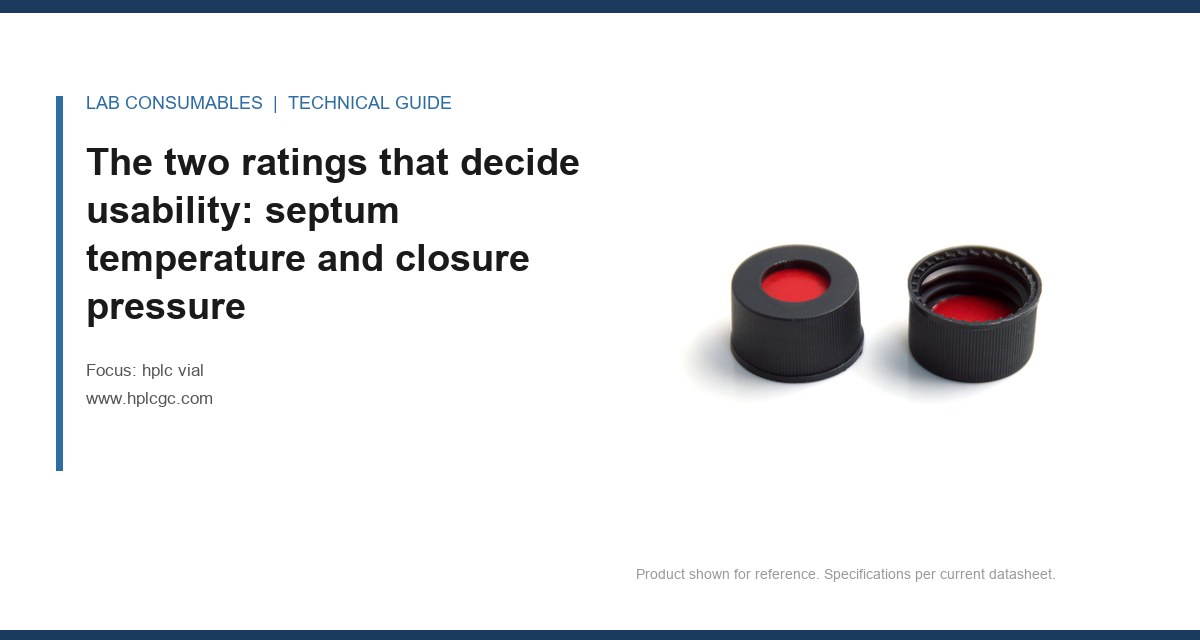
The practical consequence is that the vial should appear in the method’s robustness section as a controlled variable. A well-written method will state: “Use a 2 mL clear Type I borosilicate glass vial, 9 mm screw top, with a PTFE/silicone septum, 0.040 inch thickness, Shore A 50 durometer, pre-slit or non-slit as specified. Equivalent vials from alternate suppliers require a documented equivalence study per SOP XXX.” That one sentence prevents more deviations than any amount of auditor training.
What the USP actually requires versus what the lab must specify
Let me make the division explicit, because every lab audit I have been part of has confused the two. The USP chapters that reach the vial are <621>, <660>, <381>, <661.1>, <1225>, and <1226>. Their requirements are material-level and performance-level. They require Type I glass for injectable drug products and for most analytical applications where leachables matter. They require elastomeric closures to pass penetrability, self-sealing, and fragmentation. They require validated methods to include precision, specificity, and robustness data. They do not require a specific vial dimension, a specific septum polymer, a specific cap torque, or a specific vendor.
Those specific parameters are the lab’s specification, and they should be based on the autosampler geometry and the sample chemistry. A 9 mm screw-top vial with a 12 × 32 mm body is the de facto standard for Agilent, Waters, Shimadzu, and Thermo autosamplers, but the closure torque matters more than most analysts realize. A cap torqued to 8 to 10 inch-pounds gives a reliable seal for a PTFE/silicone septum. Below 6 inch-pounds, the seal is unreliable and evaporation becomes a factor. Above 14 inch-pounds, the septum can deform and the needle can core it. I have measured cap torque on vials from three different vendors and found a range from 4.2 to 16.8 inch-pounds on vials that all passed visual inspection. That range is enough to change headspace equilibration in a headspace vial method and enough to change injection precision in a liquid method.
Field case: the 41-injection failure that was a septum durometer problem
A pharmaceutical QC lab running a USP monograph assay for a basic drug on a C18 column started seeing a pattern: the first 30 injections of a 60-vial sequence were fine, then the RSD on the standard check vials climbed from 0.6% to 2.8% by injection 41. The analyst suspected the autosampler needle, but the needle was replaced and the pattern continued. The measurement that identified the failure was a puncture count test: the lab took ten vials from the same lot, punctured each septum with the autosampler needle 10, 20, 30, 40, and 50 times, and then measured the injection volume gravimetrically. The septum was a 0.060 inch thick PTFE/silicone with a Shore A durometer of 65. After 35 punctures, the septum began to tear at the puncture site, and the torn flap partially occluded the needle tip on subsequent injections. The fix was a switch to a 0.040 inch thick septum with a Shore A durometer of 50, pre-slit to reduce puncture force. The RSD returned to 0.7% across the full 60-vial sequence. The compendial <381> fragmentation test had passed, because the compendial test only requires a limited number of punctures with a 21-gauge needle. The method required more punctures with a smaller needle, and the lab’s own specification had to cover that gap.
Field case: the ghost peak that was a cap antioxidant, not a column bleed
A contract lab running a related substances method for a small-molecule API saw a new peak at 2.3 minutes in the blank gradient. The peak area was equivalent to 0.08% of the API peak, just under the 0.10% reporting threshold, but it was not present in the method transfer chromatograms. The lab spent three days looking at the column, the mobile phase filters, and the autosampler wash solvent. The measurement that identified the failure was a simple substitution test: the analyst filled a vial with mobile phase, capped it with a new cap, and let it sit for 24 hours, then injected it. The peak appeared. The lab then ran the same test with the glass vial only, no cap, covered with aluminum foil. The peak disappeared. The cap was a polypropylene screw cap with a PTFE/silicone septum, and the polypropylene was leaching a processing antioxidant into the mobile phase. The fix was a switch to a cap made from virgin polypropylene with no slip agent, or in the short term, a PTFE-faced cap liner that covered the entire inner surface. The USP chapters had nothing to say about this failure mode, because the cap is not in contact with the drug product in the compendial container test. But in an HPLC vial, the cap is in the headspace, and the headspace vapor contacts the sample.
Decision checklist for a USP-aligned vial specification
When I write a vial specification for a validated method, I use the following checklist. It is not a USP requirement. It is the lab’s own control document, and it closes the gap between the compendial chapters and the actual autosampler.
| Parameter | Specification | Basis |
|---|---|---|
| Glass type | Type I borosilicate, USP <660> surface test ≤ 0.10 mL/0.020 N H₂SO₄ per g | Compendial |
| Vial dimensions | 12 × 32 mm, 2 mL nominal, 9 mm screw top | Autosampler geometry |
| Septum material | PTFE/silicone, PTFE face 0.002 in, silicone core 0.038 in, Shore A 50 | Puncture and reseal performance |
| Septum type | Pre-slit for puncture counts > 3 per vial; non-slit for single injection | Method-specific |
| Cap torque | 8 to 10 inch-pounds, verified with a calibrated torque meter | Evaporation and coring control |
| Puncture rating | ≥ 40 punctures without fragmentation at 22S gauge | Lab-specific, exceeds <381> |
| Vial blank | No peak > 10% of LOQ at any target retention time | Method validation |
| Supplier change | Documented equivalence study required | <1225> and <1226> |
The puncture rating is the one most labs skip. A standard vial septum is tested by the vendor for a certain number of punctures, but that number is usually not in the vendor datasheet. If your method requires reinjection from the same vial, or if the autosampler does a needle wash inside the vial, you need to know the puncture limit. I have seen methods that reinject a standard vial five times over a 12-hour sequence, and the lab never asked whether the septum could handle five punctures without coring. The answer is usually yes for a pre-slit septum and usually no for a non-slit septum with a 26 gauge needle.
What to do when the USP method is silent on the vial and the auditor asks
An auditor will rarely ask you to show the USP chapter that specifies the vial. What they will ask is: “Show me the vial specification in the method, and show me the data that supports it.” If the method says only “HPLC vial,” you have a gap. The fix is not to point at the vendor catalog. The fix is to write the specification into the method, attach the vial blank data from the original validation or a supplementary study, and document the supplier qualification. That takes about two days of work and prevents a finding that can hold up a batch release.
For methods adopted from Agilent or Thermo Fisher application notes, the vial is often specified by part number. That is acceptable as long as the part number is in the method and the lab has a change control process. The problem arises when the part number is discontinued or the lab switches to a lower-cost equivalent. At that point, the equivalence study is not optional. I have seen a lab switch from a branded vial to a generic equivalent and lose 15% recovery on a polar analyte because the generic vial had a different glass surface treatment. The USP chapters did not catch it, because both vials were Type I glass. The method’s own robustness data should have caught it, but the lab had not tested vial-to-vial variability as a robustness factor.
USP <1225> lists robustness as “a measure of its capacity to remain unaffected by small but deliberate variations in method parameters.” The vial is a method parameter. A small variation in septum durometer, glass surface chemistry, or cap liner material is a deliberate variation that the method should tolerate or that the specification should control. If you have not tested it, you have not validated that part of the method.
Where the USP leaves room for the lab’s own judgment
The USP chapters covering containers and elastomers were written for pharmaceutical packaging, not for analytical consumables. That is the source of most confusion. <660> tests the glass as a container for a drug product, not as a sample holder in an autosampler. <381> tests the elastomer as a closure for a vial of injectable drug, not as a resealable septum for a needle that will puncture it 40 times. The compendial tests are necessary but not sufficient. They establish that the materials are safe for contact with pharmaceuticals. They do not establish that the materials are analytically clean at your detection wavelength, or that they will reseal after your autosampler’s needle geometry, or that they will not core at your puncture count.
That is not a defect in the USP. It is a division of responsibility. The USP sets the floor for material quality. The lab sets the specification for analytical performance. A validated method that treats the vial as a controlled variable, with a written specification and supporting data, is defensible in an audit. A method that treats the vial as a commodity is not. The difference shows up in RSD values, ghost peaks, and failed investigations, long before an auditor ever asks the question.
The decision rule I give to labs is this: if the method validation report does not name the vial, the septum, and the cap, and if it does not contain a vial blank chromatogram, the method is not fully validated for the consumable. The USP chapters will not tell you that directly. They will only tell you what the materials must be. The rest is yours.
References & further reading
Related resources from our lab consumables network:
- Hplc Vial at hplcgc.com
- Autosampler Vial at autosamplerhplc.com
- Vial at vials-filters.com
- Headspace Vial at headspacevialsupplier.com
External references and standards: